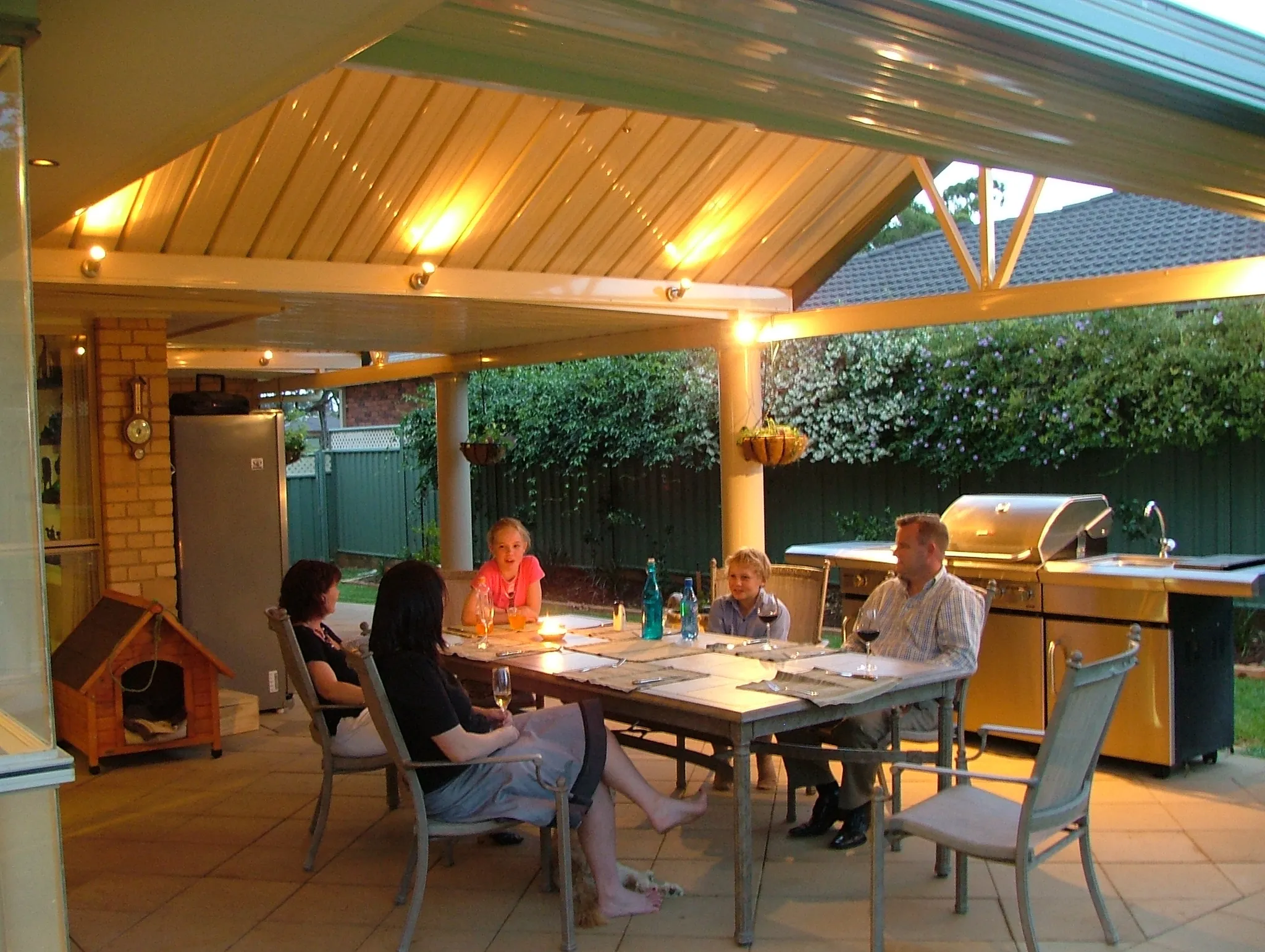
Three quotes, three different numbers, and no obvious reason why. More often than not, the difference is in the structure itself.
Most people think about a patio for a couple of summers before they do anything about it. Then the decision gets made, and three quotes land on the kitchen bench.
Choosing between them comes down to three things: whether the patio builder is licensed, whether the quote describes what’s being built, and whether they’ll come back if something goes wrong. Price matters too. Just look at it last.
That first one isn’t a matter of opinion. In New South Wales, building work worth more than $5,000 has to be done by a licensed builder, and almost any patio costs more than that.
Here’s what to look at, in the order that matters.
The short version
- Check the builder holds a current NSW contractor licence, free on the NSW Verify licence register.
- Compare what each quote is building, not what each quote costs. Two patio quotes are rarely for the same structure.
- Ask what sits outside the quote. Concreting often does.
- Lead times run in months, not weeks, so start earlier than feels necessary.
Check the Licence First, Because in NSW It Isn’t Optional
Before you sign anything, confirm you’re dealing with a licensed patio builder. A search of the public register is free and takes about a minute.
The $5,000 Rule
Under the NSW Government rules for general building work, “you must have a contractor licence to carry out, advertise or contract for building or trade work that is valued at more than $5,000 in labour and materials (including GST).” The figure counts labour and materials together, which is how a job that sounds modest ends up over the line.
A patio counts. The same NSW rules define residential building work as constructing, altering or adding to a home, and list carports and screened or glass enclosures among the examples.
So the question isn’t whether your builder needs a licence. It’s whether they’ve got one. If the patio is going on a business premises rather than a house, different rules apply and it’s worth asking your builder which.
Ben Picton, who runs Picton Bros, says licensing is the check he would want every homeowner to make. There are operators working without one. And when the work goes wrong, it’s the homeowner left carrying the consequences.
The Second Threshold Most People Have Never Heard Of
Once a job passes $20,000, your builder also has to hold home building compensation cover, usually shortened to HBC. The NSW Consumer Building Guide states that “HBC cover is required where work is worth more than $20,000 (including labour and materials).”
Home building compensation cover protects you if the builder cannot finish the job or cannot fix defective work, because they have died, disappeared, become insolvent, or had their licence suspended for ignoring a court or tribunal order to pay you. An insulated roof, a longer span, or a patio built alongside a deck or enclosure will often push a job past $20,000. Where it does, the cover isn’t optional, and you can confirm a builder holds it using the HBC Check before paying a deposit.
How to Check a Builder’s Licence
The NSW Consumer Building Guide tells consumers to “check a licence on the Public Register or by calling 13 27 00.” The register is free to search on the NSW Government’s Verify licence site. Enter the number and check the status reads current. The record shows the licence type, the registered business behind it and an expiry date, so you can see at a glance whether it is still in force.
Search by licence number rather than business name where you can. Plenty of builders trade under a name that differs from the entity holding the licence, so a name search can come back empty on a business that’s properly licensed.
A note on wording, because it trips people up. The register calls it a contractor licence, while most builders, Picton Bros included, call theirs a builder’s licence. It is the same licence under a different everyday name.
For reference, Picton Bros Panelspan holds NSW Builders Licence 83737C and is a Master Builders Association member. Ben also draws a distinction you can put to any builder: at Picton Bros it isn’t only the company that’s licensed. Every builder on the team holds their own individual licence as well.
Why Two Patio Quotes for the Same Yard Are Rarely the Same Job
Two patio quotes for the same yard usually differ because they describe different structures, not because one builder charges more for identical work.
Design Changes Are the Usual Reason the Numbers Differ
In Ben’s experience, a builder will often change something about the design, such as the roof style, a span or a post position, so their proposal stands apart from the last one you were shown. That’s not necessarily a problem, and sometimes the alternative design is the better one. It does mean the totals aren’t comparable until you’ve worked out what each one is building.
It’s worth making the comparison yourself. Put the quotes side by side and work through them item by item, rather than asking one builder to interpret another’s. Read our checklist further down for exactly what each quote should name.
What an Unusually Low Quote Can Mean
The NSW Government treats a quote well below the others as a warning sign, not a bargain. Its Consumer Building Guide tells consumers to beware of “an extremely low quote compared with others,” noting “this may indicate the job’s quality is being compromised, or that the builder may not fully understand what is required.”
On a patio, Ben says the gap between quotes mostly comes down to materials. If one comes in far below the rest, ask that builder what the quote leaves out, and which materials differ from the others, before you count it as a saving.
Building to a Budget Without Cutting the Structure
There’s a difference between building to a budget and cutting a corner, and any builder should be able to tell you where their line sits. Picton Bros will change the design to suit a budget, adjusting the size, the roof style or the scope, rather than dropping to cheaper materials.
What a Patio Quote Should Spell Out
A good quote describes a building, not a number with a logo on it. When comparing patio quotes, check that each one names all of the following before you look at the totals. Where one is missing, ask.
- The roof style. Flat, flyover, pitched, insulated, or an adjustable panel system. These are different structures at different price points, so the roof style you choose changes the total.
- Whether the roof is insulated. Insulation is often priced as an extra. A single skin roof gives you one layer of sheeting, while an insulated roof adds a foam core between two layers. Quotes for the two aren’t competing for the same job.
- Size and spans. The footprint, the height, and how far the structure reaches without a post in the way. A longer span needs bigger beams, so it costs more than the same area broken up by posts.
- Post and beam sizes. The sections the structure is built from, not just the word “steel”.
- Colour and finish. Colour choice can affect both price and lead time, particularly on insulated roofing.
- Fans, lighting and power. Settle these before the roof is built rather than after, because on an insulated roof the wiring runs inside the sheeting itself. A ceiling fan also needs a roof height of roughly two and a half to three metres to work well, which can push you towards a flyover or pitched roof. Ask whether the electrical work sits inside the quote or beside it.
- Site access. Difficult access changes the labour and sometimes the equipment. It should be priced in, not discovered on install day.
- Warranty terms, in writing. Material cover and workmanship cover are two separate promises.
- Exclusions. Everything the price doesn’t include. It’s the line people skip, and the next section covers it.
The Concreting Question Almost Nobody Asks
Concreting isn’t something Picton Bros takes on directly, and that’s worth knowing at quote stage rather than after you’ve signed. What the team does instead is organise it. The sales staff work with concreters they know. Rather than handing you a phone number and leaving you to it, they meet the concreter on site and manage that part alongside the build.
Put the same question to every builder you speak to. If a slab is needed and the quote doesn’t cover it, make sure it’s still in your budget.
Warranty, and Why “Ten Years” Isn’t the Whole Answer
Warranty terms vary by product. At Picton Bros most materials carry a ten year warranty, though some are covered for less, so the honest version is that the term depends on what you choose. Alongside that sits a workmanship warranty: if something leaks or fails because of how it was installed, the team comes back and fixes it.
That distinction matters when you’re comparing. A material warranty covers the product failing. A workmanship warranty covers the install being wrong. A builder offering only one of them is offering half the cover.
What Happens Before You Get a Quote
You don’t need to prepare anything. No council approvals, no measurements, no decision on a roof style. Picton Bros handles all of that, so there’s nothing to sort out before you pick up the phone.
Ben’s advice is to call first and let the process do the rest. There’s no obligation attached to getting a quote either. Some people go ahead straight away, and some come back a year later ready to start.
If you do want to do something beforehand, have a look through some finished patios and note the styles you like. Plenty of people arrive having done exactly that, and it gives the conversation a starting point. What gets recommended depends on how you want to use the space. The design, the materials and the options all get talked through before anything moves forward.
From there, the Picton Bros patio building process runs the same sequence on every residential job.
| Stage | What happens |
|---|---|
| 1. In-home consultation | A site visit to discuss what you want and take measurements |
| 2. Material and colour selection | Guidance on the options that suit the house |
| 3. Design and planning approval | Custom design prepared, and council requirements handled |
| 4. Quoting | A clear, upfront quote |
| 5. Manufacturing | Components made to order at the Dubbo factory |
| 6. Installation | Installed by the team, site left tidy |
| 7. Final walkthrough | The finished build reviewed together |
| 8. Ongoing support | Support continues after handover |
Get Everyone Who Is Deciding in the Same Room
Book the consultation for a time when everyone involved in the decision can be there. Picton Bros will try to arrange it that way, and it spares the household an argument that only exists because somebody missed the conversation.
Even with good notes, some questions only surface while you’re looking at the options together. Being there means they get answered on the spot instead of saved up for later.
Why Timing Matters More Than Most People Expect
A Picton Bros patio takes months to go from quote to install, so start the conversation well before you want to use the space. A patio you want for summer entertaining is a conversation to start in autumn or winter.
How long you wait depends on the time of year, the branch building it, and the size and complexity of the job. As a general guide, it can run from a few months to the better part of a year. The busy stretch is the hotter months, when everyone thinks about shade at once, and it eases off through winter.
It pays to work backwards from the date you want to be using the space, rather than forwards from the day you decide. Booking in the quieter stretch helps too, because a shorter queue means a shorter wait.
And if budget is what’s holding up the timing, Handypay lets you explore a finance quote without it affecting your credit score.
Frequently Asked Questions
Does a patio builder need a licence in NSW?
Yes, because almost every patio passes the $5,000 threshold that triggers the licensing requirement. The detail people miss is that the licence has to cover the right class of work, because a current licence in an unrelated trade isn’t a builder’s licence. The register lists the type and the status, so if you want the class of work confirmed, Building Commission NSW can tell you on 13 27 00. Licensing and insurance are also separate things, so confirming one doesn’t confirm the other.
Is it normal to get multiple quotes before deciding?
Yes, shopping around is a normal part of the process, and two or three quotes is plenty. Past three, each extra quote is another set of line items to match up, so the comparison gets slower without getting clearer. Give every builder the same brief, including size, roof style and whether you want it insulated, so the quotes start from the same place.
What should I ask a patio builder before signing?
Three questions cover most of it: what’s your licence number, what’s excluded from this quote, and what happens if something fails six months after installation. The last one is the most revealing, because it separates builders who treat handover as the end of the job from those who treat it as the start of the warranty. Get the answer in writing rather than as a verbal promise.
Should council approval be sorted before I get patio quotes?
No, you can call a builder first. Whether a patio needs approval depends on its size, height and where it sits on the block, under rules that apply across NSW. Councils differ in the paperwork they ask for, and Picton Bros’ council application team handles that at the design stage, including plans and specifications where they’re needed.
How long does it take to get a patio built?
Usually months rather than weeks, but very little of that is construction. Much of it is the queue for an install date, which runs longest in the hotter months, plus council approval where it’s needed, which runs to the council’s or certifier’s timetable rather than the builder’s. Ask for the current timeframe for your location rather than working from a number you read somewhere.
Is the cheapest patio quote ever the right one?
It could be, but work out why it’s cheapest first. A lower number that comes from a smaller footprint, a simpler roof style or an easier site is a legitimate saving. A good builder will tell you exactly which of those they’ve done. The concern is a lower number against an identical build, because something has to give to get there.
What is not included in a patio quote?
It varies by builder, but concreting is a common one, and it can carry a real cost. Exclusions aren’t a warning sign in themselves, because every builder has them. The problem is only ever an exclusion you didn’t know about, since an unbudgeted exclusion behaves exactly like a price rise. Get the list in writing and add it to your own numbers before comparing totals.
The Bottom Line
The builder you want is the one whose quote you can read and understand. Licensed, specific about what’s being built, clear about what isn’t included, and willing to put the warranty in writing. Price is a real consideration, but it only becomes a fair comparison once the structures behind the numbers match.
Planning a patio in Dubbo, Tamworth, Orange or the surrounding regions?
Call Picton Bros Panelspan on 1800 008 866, or have a look at the patio roof styles and options to get started. Picton Bros has been family owned since 1992 and manufactures at its own Dubbo factory, with branches in Dubbo, Tamworth and Orange serving homeowners across regional NSW.
Disclaimer: This article is general information only and is current at the time of writing. Licensing thresholds, insurance requirements and council approval rules are set by NSW Government and individual councils, and they change over time. Confirm the current requirements for your project and your address, and verify any builder’s licence on the NSW Government public register before entering into a contract.